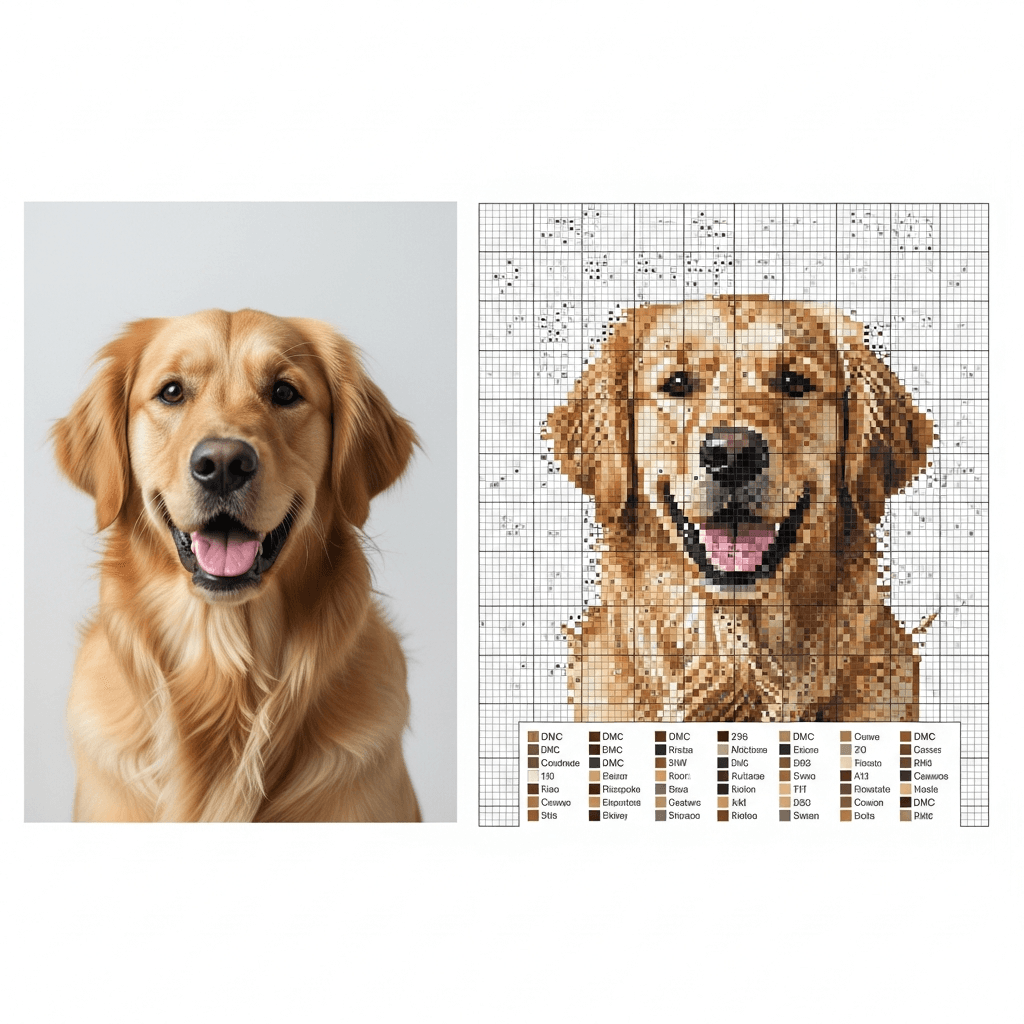
A cross stitch chart is a map. Each square tells you where a stitch goes, the symbol inside that square tells you which floss to use, and the key translates those symbols into real thread numbers. Once you understand those three parts, the chart stops looking like static and starts looking manageable.
If you want the short version, here it is:
| Part of the chart | What it means |
|---|---|
| Square on the grid | Usually one stitch |
| Symbol in the square | Which floss color to use |
| Blank square | No stitch there |
| Key or legend | The thread number that matches each symbol |
| Arrows in the margins | The center of the chart |
| Darker grid lines | Usually every 10 stitches, to make counting easier |
That is the whole system. The rest is just learning how to start in the right spot, count without drifting, and recognize the few extra marks that mean "this is not a full cross stitch."
What do the symbols on a cross stitch chart mean?
The symbols are the language of the chart.
Scarlet Quince's reading guide explains it well: the chart has a grid, each square holds a symbol, and each symbol stands for one stitch in a particular color. Blank squares mean the fabric shows through.
That matters because beginners often try to read the chart like a picture. It is not a picture. It is a coordinate system.
When you see a chart full of circles, triangles, little stars, and odd punctuation marks, do not try to memorize all of it at once. Find one symbol. Look it up in the key. Stitch that symbol in the places nearby. Then move to the next one. That is a lot easier than scanning the whole page and hoping your brain catches up.
If the key shows one floss number next to a symbol, that symbol uses one color. If it shows two floss numbers, that usually means a blend. Scarlet Quince's guide uses that exact setup and notes that a two-number symbol means you stitch with one strand of each color.
Does each square on a cross stitch chart equal one stitch?
Usually, yes.
The Cross Stitch Guild says each occupied square equals one stitch unless otherwise stated. That is the rule most charts follow, and it is the reason counted cross stitch works at all.
There are a few common exceptions:
- fractional stitches, like quarter stitches or three-quarter stitches
- backstitch lines drawn between holes instead of inside full squares
- French knots, beads, or specialty stitches marked with a separate symbol
So if you are staring at a normal square with a symbol in it, assume one full cross stitch. Do not invent extra complexity.
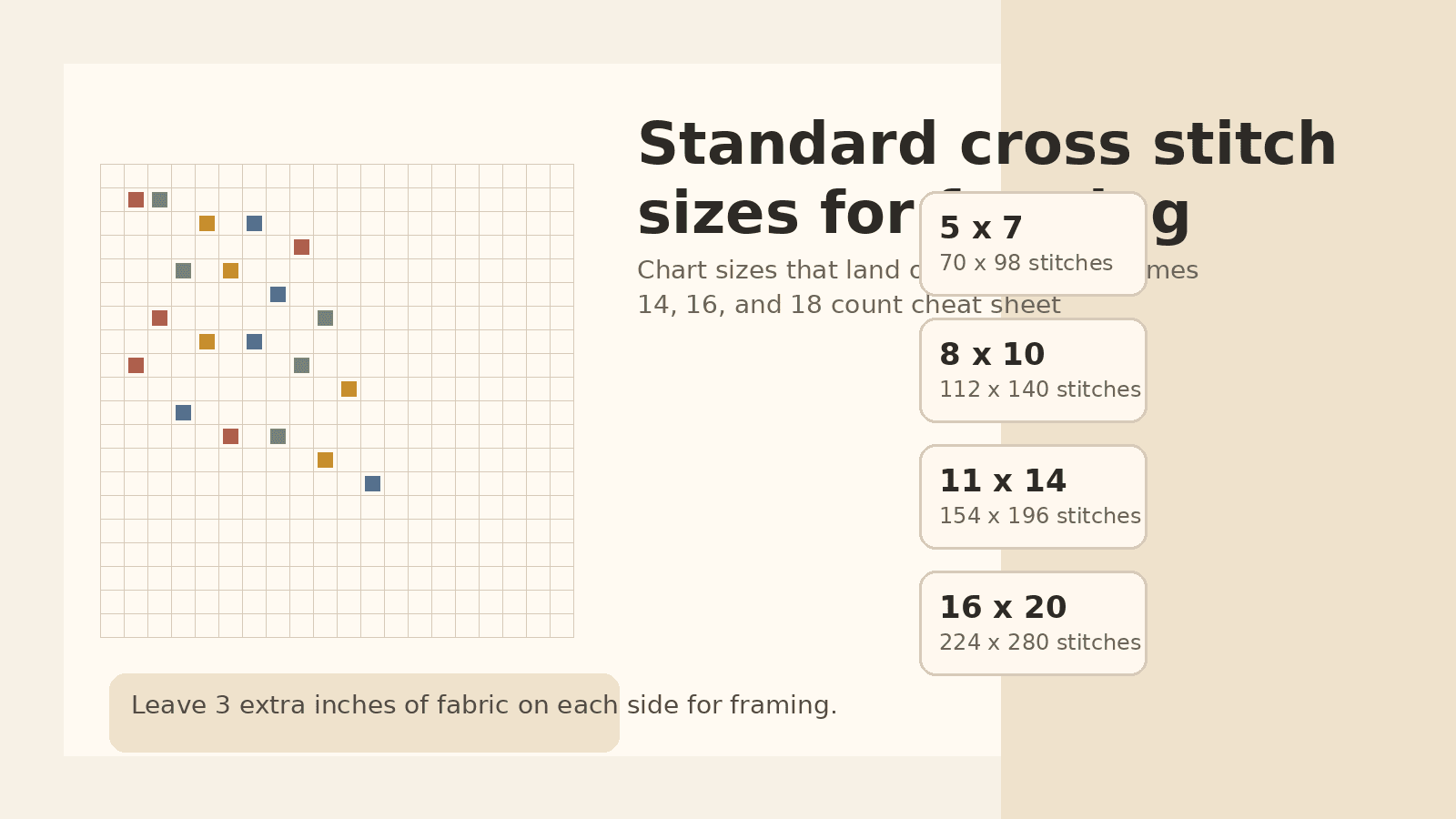
This is also where fabric count comes in. DMC says Aida count means stitches per inch, and their beginner recommendation is 14-count because it is the most popular option in their range. So if your chart is 120 stitches wide, that design will finish about 8.6 inches wide on 14-count fabric. Same chart, different fabric count, different finished size. If you want help with that part, standard cross stitch sizes for framing breaks the math down.
Where do you start on a cross stitch chart?
For most beginners, start at the center.
The Cross Stitch Guild says stitchers traditionally begin from the middle of the chart and the middle of the fabric so the design ends up centered for finishing and framing. On most charts, the center is marked with arrows in the page margins. Scarlet Quince points out that those arrows usually point between symbols, so pick one of the adjacent squares and use that as your first stitch.
Here is the easiest way to do it:
- Find the center arrows on the chart.
- Fold the fabric in half both ways, or baste a center line if you hate crease marks.
- Find the square next to the chart center that you want to start from.
- Look up that symbol in the key.
- Stitch a small block around it before you wander off.
Could you start in the top left instead? Sure. Some full-coverage stitchers do. Some kits tell you to. But center-start is the safest beginner move because it protects you from one miserable mistake: finishing half the chart and realizing the whole design is drifting off the fabric.
How do you read the key or floss legend?
The key is the decoder ring. Ignore it and the chart is useless.
In a decent pattern, the key will show:
- the symbol
- the thread brand and number
- sometimes the color name
- sometimes the stitch count for that color
The thread number matters more than the printed shade on the page. DMC says its stranded floss line is available in 500 vibrant shades, which is why pattern designers rely on numbers instead of asking you to guess between three similar greens by eye.
That is also why I would not trust a low-quality chart that gives you only colored blocks with no actual floss numbers. If the legend says DMC 310, that is black. If it says DMC 666, that is a bright red. The number is the source of truth.
This is where the DMC floss color matching guide helps too. If a chart uses older numbers, blends, or near-identical shades, get comfortable checking the actual DMC codes instead of relying on what your screen or printer thinks those colors look like.
If you are exporting from StitchLark, this part is easier because the PDF packet keeps the symbol chart tied to a DMC-coded legend, with stitch counts and both color and black-and-white chart views. That matters when you are tired and counting at night. Clear symbols beat pretty colors every time.
How do you read backstitch, half stitches, and French knots on a chart?
This is the part that throws almost everybody the first time.
Whole crosses sit neatly inside the grid. Extra stitches usually do not.
The Cross Stitch Guild notes that charts often add marks for three-quarter stitches, French knots, and other details on top of the normal full-square system. Backstitch is usually drawn as a straight line from one hole to another. Fractional stitches often show up as a diagonal mark, triangle, or partly filled square. French knots are often a dot or a special symbol.
The key is still your best friend here. If a mark does not look like a normal full stitch, stop guessing and check the legend before you put thread in fabric.
My rule is simple:
- full square with a symbol: make a full cross stitch
- line running between holes: backstitch
- partial mark inside a square: fractional stitch
- dot or specialty icon: French knot, bead, or another detail called out in the key
And one more thing. Backstitch usually comes later. Do the main cross stitches first, then add outlines, whiskers, stems, lettering, or facial details after the base layer is done. It is much easier to see where those lines belong once the blocks of color are already in place.
How do you keep your place on a cross stitch chart?
You need a system. Raw confidence is not a system.
Scarlet Quince says charts usually make every 10th grid line darker to make counting easier, and they recommend marking off completed stitches on the chart as you go. The Cross Stitch Guild gives similar advice: avoid counting across long blank stretches, and use tacking or basting lines to reduce errors.
That is the practical version:
- Work in 10 by 10 blocks when you can.
- Count from the nearest stitched area, not from some random edge of the page.
- Mark completed stitches on paper or in your pattern app.
- Grid the fabric if the chart is dense or you know you tend to drift.
If you have ever wondered why experienced stitchers keep talking about gridding, this is why. It is not a weird advanced-person ritual. It is a way to stop a two-stitch counting error from becoming a three-hour repair job.
What I would not do is count across a giant empty gap because "it should be fine." That is how people end up one row off and spend the rest of the evening pulling stitches back out.
Should you use a color chart or a black-and-white chart?
Use the one you can read fastest without second-guessing yourself.
The Cross Stitch Guild says many stitchers prefer black-and-white charts because similar shades can be hard to tell apart on color charts. I agree. A color chart looks friendly at first, but if five pinks are sitting next to each other, clean symbols win.
My preference is:
- color chart for simple designs or big blocks of color
- black-and-white chart for dense areas, similar shades, or long stitching sessions
If your pattern gives you both, switch when your eyes get tired. There is no prize for being loyal to one format.
This is another quiet advantage of a clean export. StitchLark's chart packet includes both color and black-and-white symbol pages, so you do not have to choose one version and suffer through it if it turns out to be the wrong fit.
What is the easiest way to read a cross stitch chart for the first time?
Do not try to read the whole thing. Read one small section correctly.
Find the center. Stitch one symbol. Then finish the nearby symbols in the same 10 by 10 area. Once that little block makes sense, the rest of the chart starts to feel familiar.
That first block is where beginners usually either relax or panic. If you slow down there, use the key, and respect the grid lines, you will be fine. Cross stitch charts are not hard because they are advanced. They are hard because they punish rushing.
Pull out one chart tonight and do a five-minute audit before you stitch anything:
- Find the center arrows.
- Check whether each square equals one stitch or whether the pattern uses fractional stitches.
- Read the legend until you can identify the first two or three symbols without hunting.
- Pick one 10 by 10 area and work only that section.
That is enough to get moving. If the chart came from a photo conversion and still feels noisy, check whether you are looking at useful detail or confetti that needs fixing before you commit. How to turn a photo into a cross stitch pattern shows how to start from a chart that is easier to read in the first place.